Cat 6A & Fiber Cabling: The Science Behind No-Dead-Zone Wi-Fi
Fast internet plans and powerful routers promise smooth streaming and instant connections, but many homes still struggle with weak signals, buffering, and frustrating Wi-Fi dead zones. The problem usually isn’t the internet speed or the brand of router. It’s the invisible infrastructure behind the walls.
Modern homes are packed with connected devices: TVs, laptops, smart lights, cameras, speakers, and work-from-home systems. When all of them rely on wireless signals alone, congestion and signal loss are almost guaranteed. Walls, floors, metal framing, and even furniture quietly weaken Wi-Fi before it reaches every room.
This is where science-based network design makes the difference. Cat 6A structured cabling, fiber-optic backbones, and professional Wi-Fi heat mapping create a solid foundation that wireless alone cannot replace. Instead of hoping a signal reaches the far corner of the house, professionals design networks that deliver it, cleanly, evenly, and reliably.
A properly cabled home doesn’t just feel faster. It feels calm. Video calls stay clear, smart devices respond instantly, and every room works the way it should. At MK Technology, this structured approach turns Wi-Fi from a daily frustration into a seamless whole-home experience.
Key takeaway: Strong Wi-Fi starts with professional cabling and scientific design, not just better routers.
Most Wi-Fi problems come from poor infrastructure, not slow internet plans.
Wireless signals weaken as they pass through walls, floors, glass, and metal framing.
Cat 6A cabling delivers stable, high-speed data to access points without interference.
Fiber-optic backbones handle extreme bandwidth and future tech with zero signal loss.
Adding more routers often creates interference, not better coverage.
Wi-Fi heat mapping uses real measurements to place access points exactly where needed.
Wired backbones allow Wi-Fi to stay fast even with many connected devices.
Proper design supports streaming, gaming, video calls, and smart-home systems at once.
A no-dead-zone home is not accidental, it’s engineered.
Key takeaway: Reliable whole-home Wi-Fi is built on cabling science and precise planning, not guesswork.
Key Benefits
Eliminates Wi-Fi dead zones across the entire home
Consistent speeds in every room, not just near the router
Handles high device loads without slowdowns
Cleaner, more stable connections for work, streaming, and smart homes
Future-ready infrastructure for new Wi-Fi standards and technology
Key takeaway: Proper cabling turns Wi-Fi from unpredictable to consistently reliable.
Q/A
Q: Why doesn’t adding more routers or extenders fix Wi-Fi dead zones?
A: Because Wi-Fi isn’t just about signal strength, it’s about signal quality. Extra routers often compete with each other, causing interference, dropped connections, and uneven speeds. Without a wired backbone, each access point is still limited by wireless backhaul. Cat 6A and fiber provide a clean, stable data path so every access point performs at full capacity.
Key takeaway: More hardware doesn’t help if the network foundation is weak.
The Science Behind a No-Dead-Zone Wi-Fi Network
Wi-Fi is often treated like magic, plug in a router and expect it to work everywhere. In reality, wireless signals follow strict physical rules. As radio waves travel, they lose strength through distance, walls, floors, and materials like concrete, steel, and glass. This natural signal loss, called attenuation, is the main reason dead zones appear.
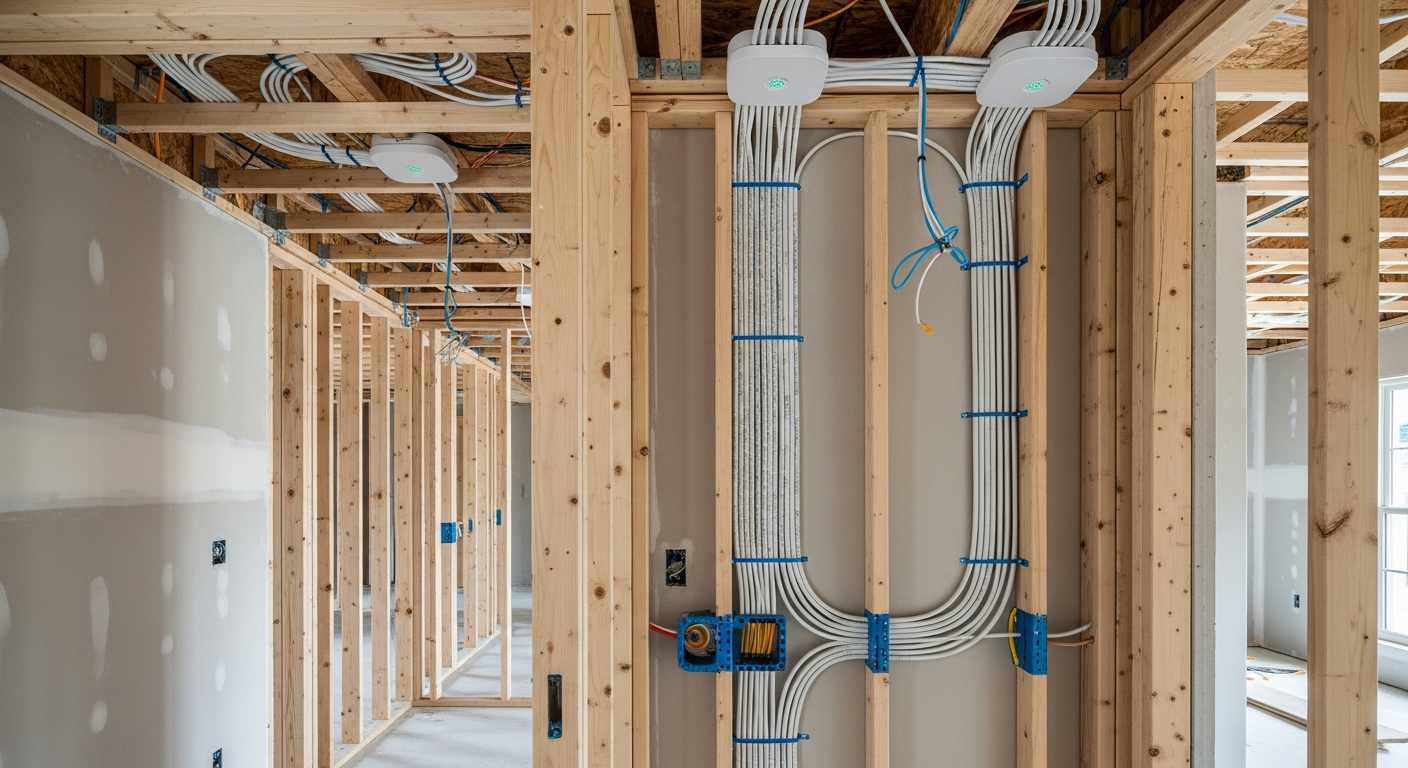
A no-dead-zone network starts by accepting one simple fact: wireless works best when it’s supported by wired infrastructure. Cat 6A structured cabling creates dedicated data paths from the network core to each access point. Instead of “stretching” one signal across the home, the network delivers fresh, full-strength Wi-Fi exactly where it’s needed.
Fiber-optic cabling takes this concept even further. Because fiber uses light instead of electricity, it carries massive amounts of data without interference, latency, or distance limitations. In larger homes, fiber becomes the perfect backbone between network closets, floors, or detached spaces.
Together, Cat 6A and fiber shift Wi-Fi from a guessing game to a controlled system. Access points are no longer fighting for bandwidth or relying on weak wireless hops. They become precise tools, each serving a defined area with predictable performance.
At MK Technology, this science-first approach ensures Wi-Fi coverage is planned, measured, and proven, long before homeowners experience a single dropped connection.
Key takeaway: Strong Wi-Fi depends on physics, and wired design is how you control it.
Wi-Fi signals naturally weaken through walls and distance
Dead zones are a physics problem, not a router problem
Cat 6A delivers full-speed data directly to access points
Fiber provides interference-free, long-distance bandwidth
Wired backbones turn Wi-Fi into a predictable system
Key takeaway: Control the structure, and Wi-Fi performance follows.
How Structured Cabling and Heat Mapping Remove Wi-Fi Dead Zones
Every home is different, and that’s why one-size-fits-all Wi-Fi solutions fail. Floor plans, ceiling height, wall materials, furniture layout, and even appliances all affect how wireless signals behave. Professional network design starts by measuring reality, not guessing.
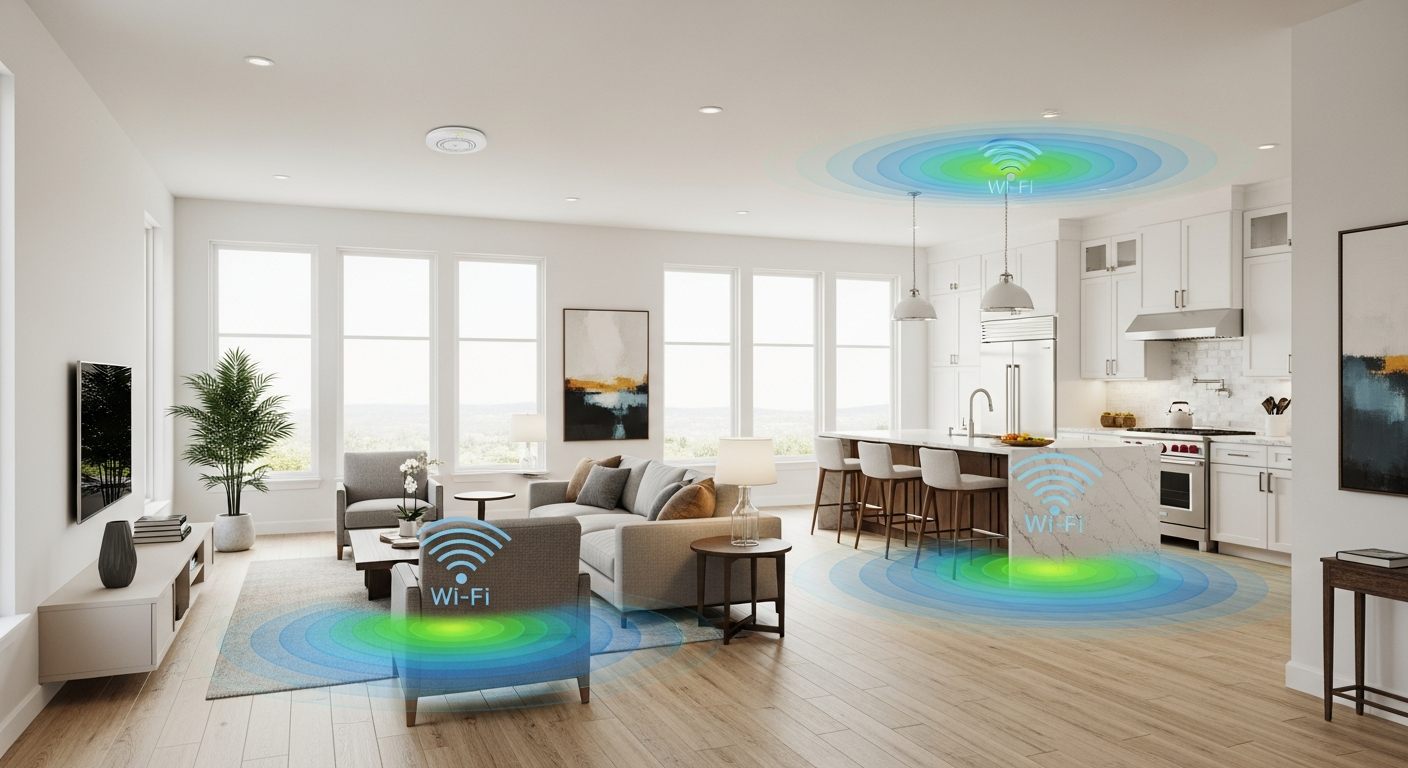
Wi-Fi heat mapping uses specialized software and on-site testing to visualize signal strength, interference, and coverage gaps throughout the home. Instead of placing access points “where they fit,” technicians position them where performance is scientifically proven. This ensures each access point covers its zone cleanly, without overlap or competition.
In new-build homes, Cat 6A and fiber are planned during construction, allowing access points to disappear into ceilings and walls while delivering perfect coverage from day one. In renovations, cabling is carefully routed to strengthen weak areas like basements, offices, media rooms, and outdoor spaces.
The result is immediately noticeable. Video calls stay stable in home offices. Streaming remains smooth in bedrooms and kitchens. Smart devices respond instantly instead of dropping offline. Even high-demand activities, like gaming or 4K streaming, run reliably at the same time.
At MK Technology, heat mapping turns Wi-Fi from trial-and-error into a tested design, so homeowners experience consistent performance in every room, every day.
Key takeaway: Measured design, not guesswork, is what removes Wi-Fi dead zones.
Q/A
Q: Is fiber really necessary inside a home?
A: In many modern homes, yes. Fiber is ideal for connecting network hubs, floors, and high-demand areas because it handles extreme bandwidth without interference or signal loss. As device counts grow and speeds increase, fiber prevents bottlenecks that copper alone may face. It’s not always required everywhere, but where it’s used, performance and longevity improve significantly.
Key takeaway: Fiber isn’t about today’s speed, it’s about tomorrow’s stability.
Cat 6A vs Fiber Optic Cabling: Building a High-Performance Home Network
Cat 6A and fiber-optic cabling often work best together, each serving a specific role in a high-performance home network. Understanding their differences explains why professional designs rarely rely on only one type.
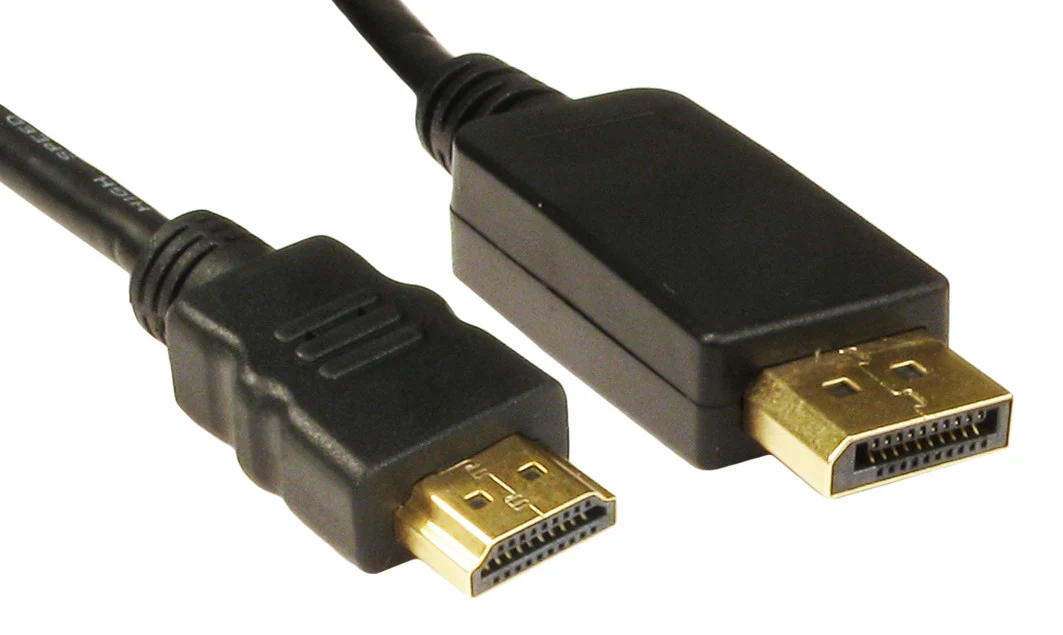
Cat 6A is a copper-based cable designed for up to 10 Gbps speeds over long distances within a home. It supports Power over Ethernet (PoE), allowing access points, cameras, and smart devices to receive both data and power through a single cable. Its shielding reduces interference, making it ideal for feeding Wi-Fi access points room by room.
Fiber-optic cabling uses light instead of electrical signals. This means zero electromagnetic interference, ultra-low latency, and the ability to move massive amounts of data over long distances without degradation. Fiber is perfect as a backbone between network closets, floors, or separate buildings where copper may struggle.
In practice, fiber acts as the highway, while Cat 6A serves as the local roads. Fiber carries data effortlessly across the home, and Cat 6A delivers it precisely to devices and access points. This layered approach prevents congestion and ensures consistent speeds everywhere.
At MK Technology, cable selection is based on layout, device load, and future growth, not guesswork, so the network performs reliably today and stays ready for what’s next.
Key takeaway: Cat 6A and fiber aren’t competitors, they’re complementary.
Recap
Cat 6A delivers 10Gb speeds with PoE support
Fiber provides interference-free, ultra-high bandwidth
Copper is ideal for local device connections
Fiber excels as a long-distance network backbone
Combining both prevents bottlenecks and signal loss
Key takeaway: The strongest home networks use the right cable in the right place.
Future-Proofing Your Home Wi-Fi With Professional Network Design
Home networks rarely stay the same. Each year brings more devices, higher-resolution streaming, smarter security systems, and heavier work-from-home demands. A future-proof network plans for growth instead of reacting to it.
One key principle is overbuilding the backbone. Installing Cat 6A instead of older cabling, and adding fiber where possible, ensures the infrastructure can handle future Wi-Fi standards like Wi-Fi 6E and Wi-Fi 7 without needing new walls opened later. The cabling stays hidden, but its benefits last for decades.
Another expert tip is zoning. Separate access points for offices, media rooms, and high-traffic areas prevent one activity from affecting another. Wired backhaul ensures each zone performs independently and reliably.
Planning extra cable runs is also critical. Even unused lines act as insurance for future upgrades, new cameras, outdoor Wi-Fi, or advanced AV systems can be added without disruption. This approach saves time, cost, and stress over the life of the home.
At MK Technology, future-proofing is part of every design. By combining structured cabling, fiber backbones, and measured Wi-Fi planning, homeowners gain a network that feels fast today and stays effortless tomorrow.
Key takeaway: Planning ahead is the simplest way to avoid costly network upgrades later.
Q/A
Q: Can I add this infrastructure later, or should it be done upfront?
A: It can be added later, but it’s always easier and more cost-effective to plan upfront, especially in new builds or major renovations. Retrofitting often means opening walls, rerouting cables, and making compromises. Installing Cat 6A and fiber early creates a clean foundation that supports future upgrades without disruption.
Key takeaway: Early planning saves money, time, and long-term frustration.
Wi-Fi dead zones are caused by physics, materials, and poor infrastructure, not weak internet plans
Wireless signals perform best when supported by wired backbones
Cat 6A structured cabling delivers fast, stable data to each access point
Fiber-optic cabling provides interference-free, high-capacity connections across the home
Wi-Fi heat mapping replaces guesswork with measured, proven coverage
Professional access point placement prevents congestion and overlap
Wired backhaul keeps speeds consistent, even with many connected devices
Proper cabling supports smart homes, streaming, gaming, and remote work
Combining Cat 6A and fiber future-proofs the network for new standards
Planning infrastructure early avoids expensive retrofits later
Key takeaway: A no-dead-zone Wi-Fi home is engineered through cabling science, not trial and error.
If your Wi-Fi feels inconsistent, the solution isn’t another router, it’s a smarter foundation. Cat 6A structured cabling, fiber-optic backbones, and professional Wi-Fi heat mapping transform connectivity into something reliable, calm, and effortless.
At MK Technology, networks are designed scientifically, installed cleanly, and built to last. Whether you’re planning a new build, renovating, or upgrading an existing home, the right infrastructure makes every device work better, now and in the future.
Ready to eliminate Wi-Fi dead zones for good? Start with a professional network design consultation today.